Rare & Endangered Animals · Supporting guide
Purple Frog: The Living Fossil Amphibian of India's Western Ghats
Discovered by science only in 2003, the purple frog is a burrowing amphibian whose lineage diverged from all other frogs around 100 million years ago.
 By Mahmoud OsamaSenior Wildlife Researcher & Editor-in-ChiefPublished 2 November 2025 · Updated 2 November 2025 · 6 min read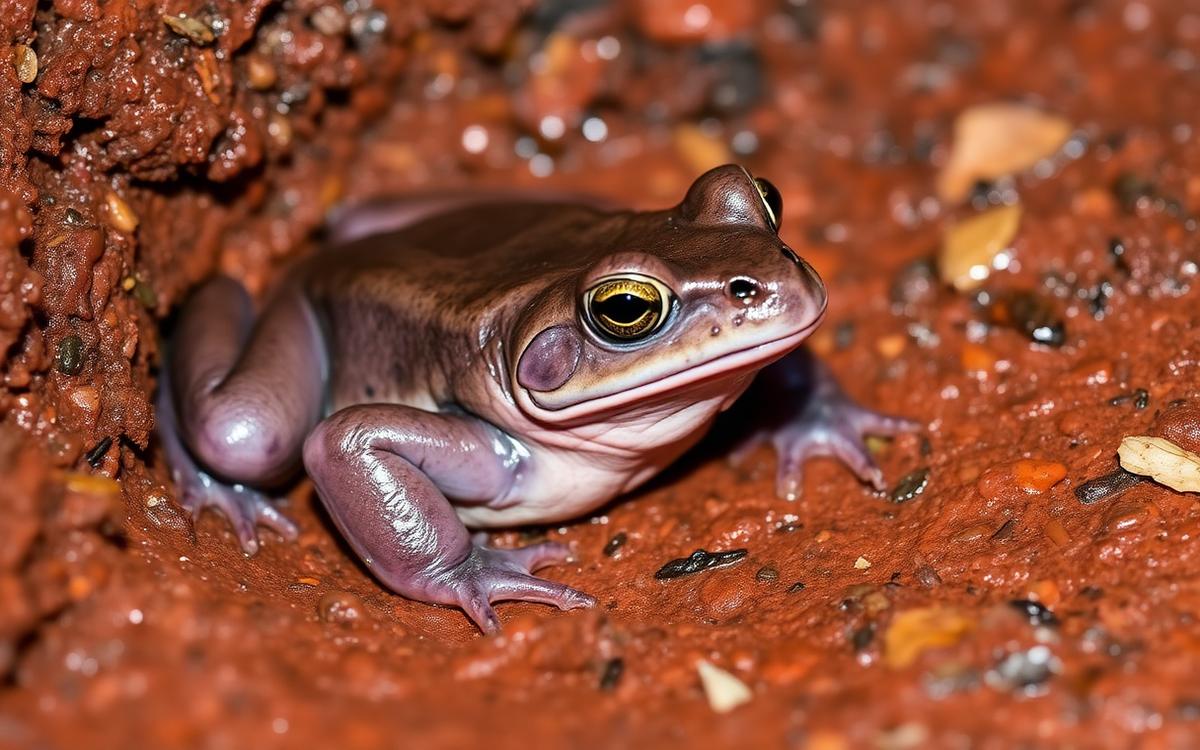
Reviewed against primary toxinology literature and IUCN assessments. This article is educational and is not medical advice — in an emergency contact your local poison centre or emergency services.
The purple frog, scientifically named Nasikabatrachus sahyadrensis, is one of the strangest amphibians alive. It has a bloated, purple-gray body, a pointed snout, and tiny limbs, and it spends almost its entire life several feet underground, surfacing for only about two weeks a year to breed during the monsoon.
Formally described by scientists in 2003, the purple frog belongs to a lineage that genetic analysis suggests split off from all other living frogs roughly 100 million years ago, earning it the nickname 'living fossil.' It survives today only in a narrow stretch of India's Western Ghats mountains, a biodiversity hotspot under mounting development pressure.
Discovery of an Ancient Lineage
Local communities in Kerala had long known of the purple frog, but it was not formally described in scientific literature until 2003, when researchers recognized it as so distinct from every other known frog family that it warranted its own family, Nasikabatrachidae. Genetic studies placed its closest living relatives in the Seychelles islands, a striking result explained by the ancient breakup of the supercontinent Gondwana, which once connected India, Madagascar, and the Seychelles.
Editor's note: Molecular clock estimates suggest the purple frog lineage diverged from its closest relatives around 100 million years ago, predating the extinction of the dinosaurs.
An Almost Entirely Subterranean Life
Purple frogs spend the vast majority of the year underground, using powerful, spade-like limbs to burrow several feet deep in loose soil, where they feed primarily on termites and ants using a specialized tongue. Their bloated, rounded body shape is adapted for pushing through soil rather than for swimming or jumping.
- Spends roughly 350 days a year underground
- Surfaces briefly during monsoon rains to breed in fast-flowing streams
- Tadpoles develop in fast water, using a suction mouth to cling to rocks
- Adults have tiny eyes and reduced vision compared to surface-dwelling frogs
A Narrow Range Under Pressure
Purple frogs are found only in a limited area of the southern Western Ghats, primarily in Kerala, India, a mountain range recognized as one of the world's biodiversity hotspots due to its extraordinarily high number of endemic species found nowhere else.
Habitat threats
Their breeding streams and surrounding forest are increasingly affected by plantation agriculture, sand mining, and infrastructure development, all of which can disrupt the very specific stream conditions the species needs for successful breeding and tadpole development.
Conservation Status
The IUCN lists the purple frog as Endangered, citing habitat degradation across its narrow range. Because it spends nearly all year hidden underground, monitoring population trends is unusually difficult, and researchers rely largely on brief monsoon breeding surveys to estimate its status.
- Listed as Endangered on the IUCN Red List
- Endemic to a narrow band of the southern Western Ghats
- Protected within parts of its range by Indian wildlife sanctuaries
- Difficult to monitor due to its almost entirely subterranean lifestyle
Scientific and Ecological Significance
Beyond its evolutionary novelty, the purple frog is considered an indicator species for the health of Western Ghats stream ecosystems, since its breeding success depends on clean, fast-flowing water. Its conservation is closely tied to broader efforts to protect the region's forest and river systems from unchecked development.
Key takeaways
- The purple frog was formally described by science only in 2003, despite being known locally for generations.
- Its lineage is estimated to have diverged from other frogs around 100 million years ago.
- It spends roughly 350 days a year underground, surfacing briefly to breed during monsoon season.
- It is found only in a narrow area of India's Western Ghats biodiversity hotspot.
- The IUCN lists the species as Endangered due to habitat degradation.
Frequently asked questions
Why is the purple frog called a 'living fossil'?+
Genetic analysis suggests its lineage split from all other living frogs roughly 100 million years ago, making it an evolutionarily distinct relic with no close living relatives outside the Seychelles.
Where does the purple frog live?+
It is found only in a narrow region of the southern Western Ghats mountains in Kerala, India.
What does the purple frog eat?+
It feeds mainly on termites and ants, which it captures underground using a specialized, muscular tongue.
How often does the purple frog come above ground?+
It surfaces for only about two weeks a year, during monsoon rains, to breed in fast-flowing streams.