Rare & Endangered Animals · Supporting guide
Black-Footed Ferret Recovery: Bringing Back North America's Rarest Mammal
Declared extinct twice before a small wild population was found in 1981, the black-footed ferret survives today only through an intensive captive breeding program.
 By Mahmoud OsamaSenior Wildlife Researcher & Editor-in-ChiefPublished 18 October 2025 · Updated 18 October 2025 · 7 min read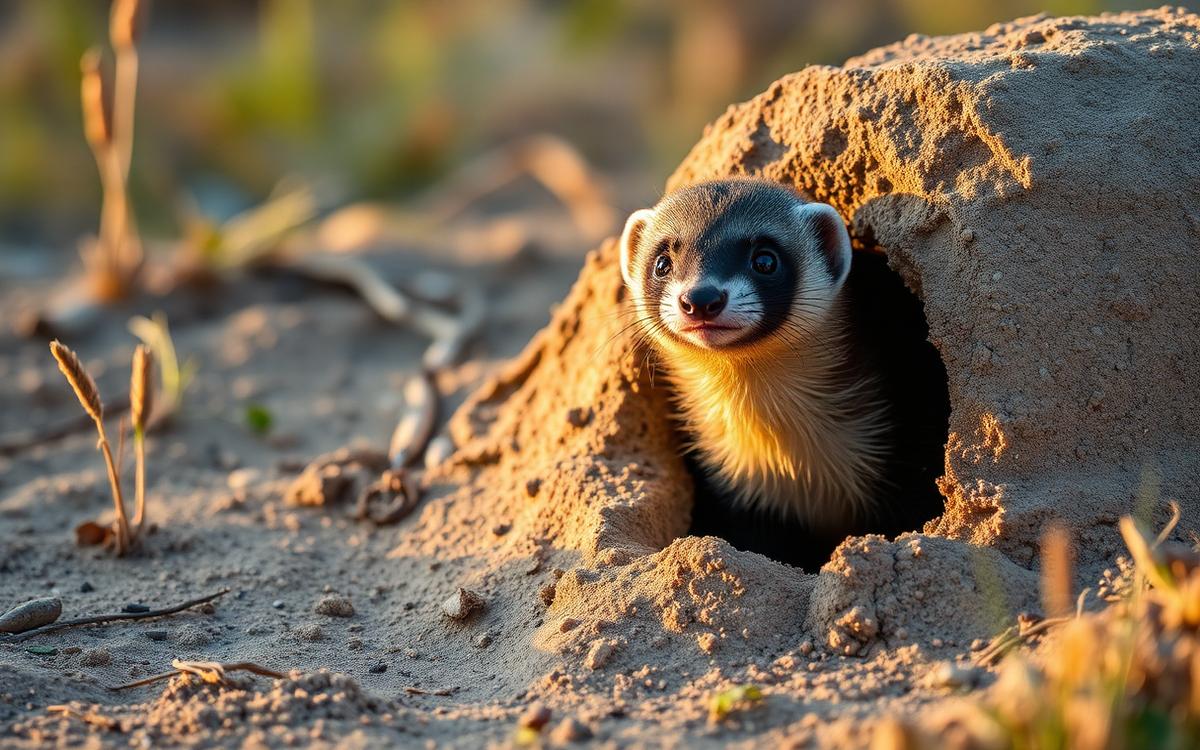
Reviewed against primary toxinology literature and IUCN assessments. This article is educational and is not medical advice — in an emergency contact your local poison centre or emergency services.
The black-footed ferret has been declared extinct twice in the last century, only to be rediscovered each time. By the early 1980s it was believed gone from the wild entirely until a ranch dog in Wyoming brought home a dead ferret, leading biologists to a tiny surviving colony. That population became the foundation for one of the most intensive captive breeding programs in American conservation history.
Today, black-footed ferrets survive largely because of that program. They remain one of North America's rarest mammals, tightly bound to a single prey species — prairie dogs — whose own decline across the Great Plains has been the ferret's central and ongoing threat.
A Species Declared Extinct — Twice
Black-footed ferrets were considered likely extinct in 1979 after the last known captive population died out. Then in 1981, a small wild colony was discovered near Meeteetse, Wyoming. Disease outbreaks — canine distemper and sylvatic plague — nearly wiped out that population too, prompting wildlife agencies to capture the last 18 individuals in the mid-1980s to start a captive breeding program.
Editor's note: All black-footed ferrets alive today are descended from just seven of those 18 founder individuals, giving the species an unusually narrow genetic base.
Dependence on Prairie Dogs
Black-footed ferrets are extreme dietary specialists: prairie dogs make up the vast majority of their diet, and ferrets also use abandoned prairie dog burrows for shelter and raising kits. As prairie dog colonies across the Great Plains were poisoned, plowed under for agriculture, and hit by introduced sylvatic plague, ferret habitat collapsed alongside them.
- Prairie dogs make up roughly 90 percent of a ferret's diet
- Ferrets live almost exclusively within prairie dog burrow systems
- Sylvatic plague, introduced from Asia, kills both prairie dogs and ferrets directly
- An estimated 95 percent+ reduction in prairie dog range since the 1900s
The Captive Breeding Program
Since the 1980s, the U.S. Fish and Wildlife Service's National Black-Footed Ferret Conservation Center in Colorado has bred thousands of ferrets for release, using careful genetic pairing to maximize diversity from the narrow founder population. Kits are raised with minimal human contact and given pre-release training in outdoor pens to build hunting and burrowing skills before reintroduction.
Cloning as a genetic rescue tool
In 2020, scientists successfully cloned a black-footed ferret named Elizabeth Ann from cell lines preserved decades earlier from a ferret that left no living descendants, introducing genetic diversity absent from the current breeding population — a first for a U.S. endangered species.
Reintroduction Sites and Ongoing Challenges
Captive-bred ferrets have been released at dozens of sites across the western United States, Canada, and Mexico, though wild population sizes remain small and highly dependent on the health of local prairie dog colonies. Vaccination programs against plague, both in ferrets and experimentally in prairie dogs, have become a standard part of reintroduction efforts.
Outlook
The black-footed ferret remains listed as Endangered, and biologists estimate only a few hundred individuals persist in the wild at any time, sustained largely by ongoing releases. Its recovery is inseparable from the fate of prairie dog colonies, making prairie ecosystem protection just as important as ferret-specific breeding efforts.
Key takeaways
- The black-footed ferret was believed extinct twice before a small wild colony was found in Wyoming in 1981.
- All living ferrets descend from just seven founder individuals captured in the 1980s.
- Ferrets depend almost entirely on prairie dogs for food and shelter.
- Sylvatic plague and prairie dog habitat loss remain the species' central threats.
- In 2020, scientists cloned a ferret to introduce genetic diversity absent from the living population.
Frequently asked questions
Why was the black-footed ferret considered extinct?+
Its population crashed so severely due to prairie dog decline and disease that no individuals were known to survive in the wild by 1979, before a small colony was later discovered in Wyoming in 1981.
How many black-footed ferrets exist today?+
Only a few hundred are estimated to persist in the wild at any given time, sustained by ongoing captive breeding and release programs, alongside several hundred more in captivity.
Why are prairie dogs so important to ferrets?+
Prairie dogs make up the vast majority of a ferret's diet, and ferrets rely on prairie dog burrows for shelter, making prairie dog colony health essential to ferret survival.
What was Elizabeth Ann the cloned ferret?+
Elizabeth Ann was a black-footed ferret cloned in 2020 from cells of a ferret that died in 1988, introducing genetic diversity unavailable in the current living population.