Rare & Endangered Animals · Supporting guide
Philippine Eagle: The Rainforest's Rarest Apex Predator
With fewer than 800 individuals left, the Philippine eagle depends on vanishing old-growth forest that is disappearing faster than it can be protected.
 By Mahmoud OsamaSenior Wildlife Researcher & Editor-in-ChiefPublished 3 October 2025 · Updated 3 October 2025 · 7 min read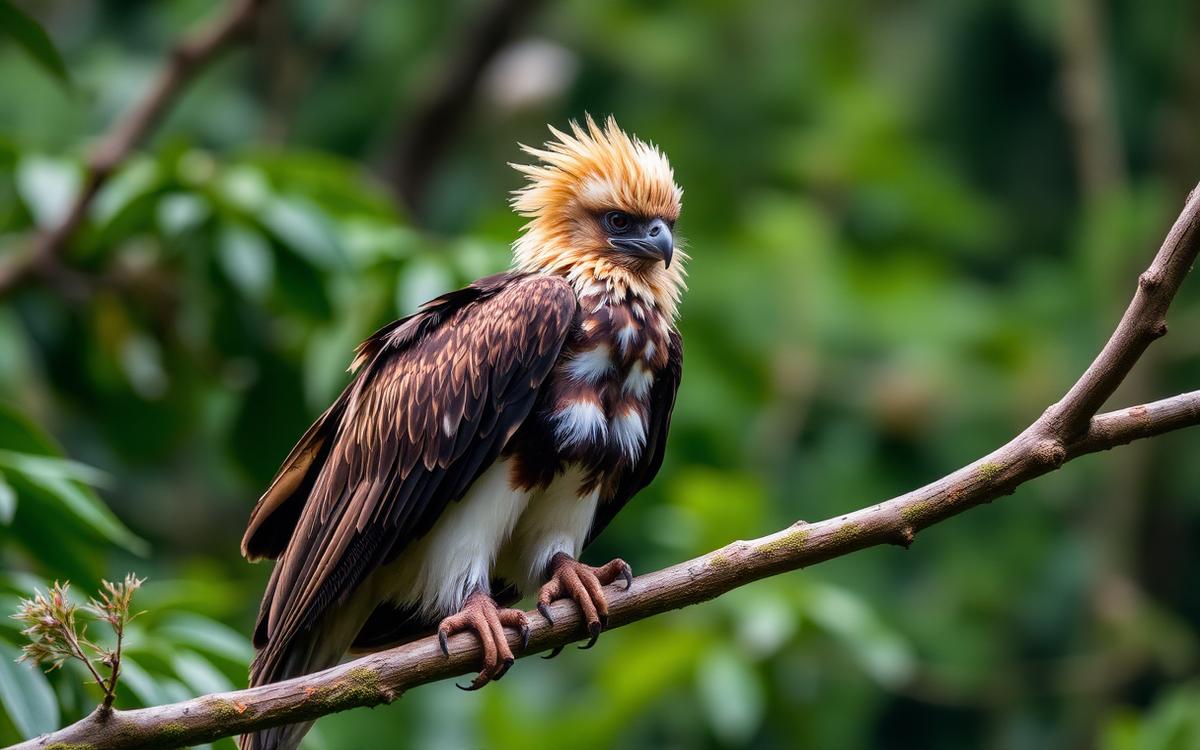
Reviewed against primary toxinology literature and IUCN assessments. This article is educational and is not medical advice — in an emergency contact your local poison centre or emergency services.
The Philippine eagle is one of the largest and most powerful eagles in the world, with a wingspan exceeding two meters and legs strong enough to snatch monkeys, flying lemurs, and civets from the forest canopy. Once known colloquially as the 'monkey-eating eagle,' it is now considered the Philippines' national bird and a symbol of the country's dwindling old-growth rainforest.
Fewer than 800 individuals are estimated to survive, confined to fragments of forest on four islands: Luzon, Samar, Leyte, and Mindanao. As the country's forests have been logged and converted to agriculture, the eagle's population has fallen in step, making it one of the rarest and most endangered raptors on Earth.
Biology and Hunting Behavior
Philippine eagles are apex predators of the forest canopy, using powerful talons and a hooked beak to capture prey ranging from flying lemurs and palm civets to snakes and monitor lizards. A breeding pair requires an enormous home range — often estimated at 20 to 40 square kilometers of forest — to find enough food to raise a single chick.
- Wingspan up to roughly 2.2 meters
- Breeding pairs raise only one chick every two years
- Chicks remain dependent on parents for up to 18 months
- Requires large tracts of contiguous old-growth or mature secondary forest
Threats to Survival
Deforestation is the dominant threat: the Philippines has lost the vast majority of its original forest cover to logging, mining, and agricultural conversion, leaving eagle habitat scattered and shrinking. Because each pair needs such a large territory, even modest additional forest loss can eliminate breeding pairs entirely.
Direct persecution
Eagles are also shot, occasionally out of fear they threaten livestock or as trophies, and young birds are sometimes caught in traps intended for other animals. Because the species reproduces so slowly, losing even a few adults per year can meaningfully affect the total population.
Conservation Programs
The Philippine Eagle Foundation, based in Davao City on Mindanao, runs a captive breeding and release program alongside forest protection and community education initiatives. Since the 1990s, captive-bred eagles have occasionally been released to bolster wild populations, though breeding success in captivity remains slow given the species' long reproductive cycle.
- Captive breeding and rehabilitation center in Davao City
- Community-based forest guard and nest-watching programs
- Satellite tracking of released and wild juveniles
- Legal protection under Philippine wildlife law with steep penalties for killing an eagle
National Symbol and Public Awareness
Declared the Philippines' national bird in 1995, the eagle has become a rallying point for forest conservation nationally. Public education campaigns emphasize both the ecological role of the species as an apex predator and the economic value of intact watersheds that surrounding communities depend on for water and flood control.
Outlook
Because Philippine eagles reproduce so slowly and need such large territories, their long-term survival depends almost entirely on whether enough contiguous forest can be preserved across their remaining island strongholds. Conservationists view Mindanao, which holds the largest surviving population, as the most critical landscape to protect.
Key takeaways
- Fewer than 800 Philippine eagles are estimated to remain in the wild.
- Breeding pairs need 20 to 40 square kilometers of forest to raise a single chick every two years.
- Deforestation for logging and agriculture is the primary driver of decline.
- Captive breeding and release programs run alongside forest protection efforts.
- The species was declared the Philippines' national bird in 1995.
Frequently asked questions
Why was the Philippine eagle called the 'monkey-eating eagle'?+
Early accounts suggested it fed primarily on monkeys, but research has shown its diet is broader, including flying lemurs, civets, snakes, and other forest animals; the species is now officially known as the Philippine eagle.
Where do Philippine eagles live?+
They are found only in the Philippines, on the islands of Luzon, Samar, Leyte, and Mindanao, with Mindanao holding the largest remaining population.
How fast do Philippine eagles reproduce?+
Very slowly for a bird — breeding pairs typically raise only one chick every two years, which limits how quickly the population can recover from losses.
Is it illegal to kill a Philippine eagle?+
Yes, Philippine wildlife law imposes severe penalties, including significant prison time, for killing a Philippine eagle.