Reptiles & Amphibians · Supporting guide
Gila Monster: One of the Few Venomous Lizards
The Gila monster's slow, deliberate demeanor hides a genuinely venomous bite, one of the few examples of venom delivery among lizards worldwide.
 By Mahmoud OsamaSenior Wildlife Researcher & Editor-in-ChiefPublished 15 October 2025 · Updated 20 December 2025 · 7 min read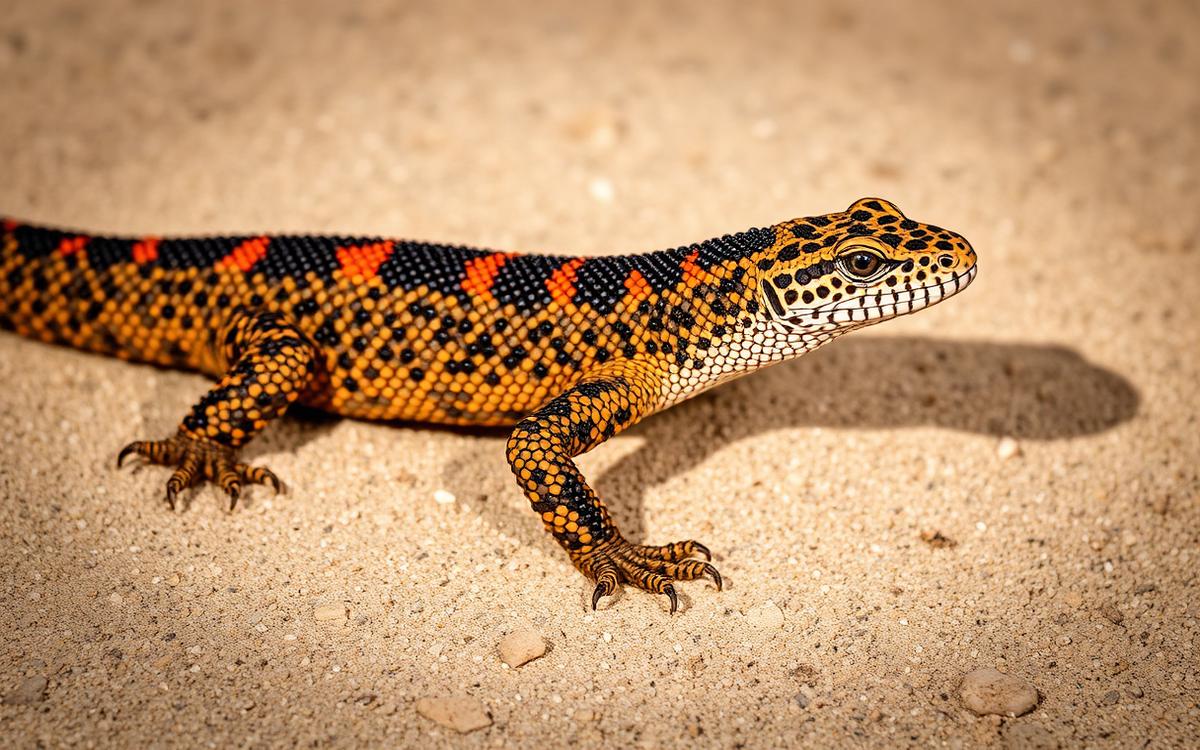
Reviewed against primary toxinology literature and IUCN assessments. This article is educational and is not medical advice — in an emergency contact your local poison centre or emergency services.
The Gila monster (Heloderma suspectum) is one of only a small number of lizard species known to be venomous, alongside its close relative the Mexican beaded lizard. Native to the deserts of the southwestern United States and northern Mexico, this slow-moving, thick-bodied lizard spends up to 95 percent of its life underground in burrows, emerging mainly to feed or breed.
Unlike snakes, which typically inject venom through hollow fangs, the Gila monster chews venom into a wound from grooved teeth in its lower jaw, delivering a painful but rarely fatal bite to humans. Its venom has also proven scientifically valuable, most notably as the basis for a class of diabetes medications derived from a hormone-like compound found in its saliva.
Biology and Appearance
Gila monsters have distinctive beaded, non-overlapping scales in bold patterns of black, orange, pink, or yellow, which likely serve as a warning to predators. They can grow up to about 60 centimeters long and store fat in their tails, allowing them to survive months without eating.
- Length: typically 35-60 cm
- Lifespan: can exceed 20 years in captivity
- Activity: mostly active in spring, retreating underground during extreme heat
- Diet: eggs, small mammals, birds, and other reptiles
Venom Delivery and Bite Effects
Gila monsters lack the pressurized injection system of venomous snakes. Instead, venom flows along grooves in the lower teeth as the lizard bites and chews, often clamping down and holding on for several minutes. Bites are extremely painful but rarely dangerous to healthy adults.
Symptoms of a bite
- Intense, immediate pain at the bite site
- Swelling and, occasionally, a significant drop in blood pressure
- Nausea and weakness in some cases
- No verified human deaths from Gila monster bites in modern records
Editor's note: If bitten, do not try to pull the lizard off; submerging the bite area in water or applying flame to the jaw has traditionally been used to encourage release, though prying gently is safer.
Medical Significance
Gila monster saliva contains exendin-4, a compound that inspired the development of exenatide, a medication used to manage type 2 diabetes by mimicking a hormone that regulates blood sugar. This discovery, made in the 1990s, remains one of the best-known examples of venom-derived medicine.
Research into Heloderma venom continues, with scientists studying additional peptides for potential use in treating diabetes and other metabolic conditions.
Habitat and Conservation
Gila monsters live in the Sonoran, Mojave, and Chihuahuan deserts of the U.S. Southwest and northwestern Mexico, favoring rocky foothills and desert scrub. They are protected by law in most U.S. states where they occur, and it is illegal to collect or kill them without a permit.
- IUCN status: Near Threatened
- Threats: habitat loss from urban development, illegal collection
- Protected under state law in Arizona, Nevada, Utah, and New Mexico
Key takeaways
- The Gila monster is one of the few genuinely venomous lizards in the world.
- It delivers venom by chewing rather than injecting it through fangs.
- Bites are extremely painful but not typically life-threatening to humans.
- Its venom led to the development of a diabetes medication, exenatide.
- The species is Near Threatened and legally protected across its U.S. range.
Frequently asked questions
Is the Gila monster deadly to humans?+
No confirmed modern human deaths have resulted from Gila monster bites; they are painful but rarely dangerous to healthy adults.
How does the Gila monster deliver venom?+
It chews venom into the wound through grooved teeth in its lower jaw rather than injecting it like a snake.
Why is Gila monster venom important for medicine?+
A compound in its saliva led to the diabetes drug exenatide, which mimics a blood-sugar-regulating hormone.
Where do Gila monsters live?+
They inhabit deserts of the southwestern United States and northwestern Mexico.
Are Gila monsters endangered?+
They are listed as Near Threatened by the IUCN and are legally protected in the states where they occur.