Reptiles & Amphibians · Supporting guide
Coral Snake vs. Milk Snake: How to Tell Them Apart
Bright red, yellow, and black bands can mean a harmless milk snake or a highly venomous coral snake, and getting the identification wrong matters.
 By Mahmoud OsamaSenior Wildlife Researcher & Editor-in-ChiefPublished 15 November 2025 · Updated 25 January 2026 · 6 min read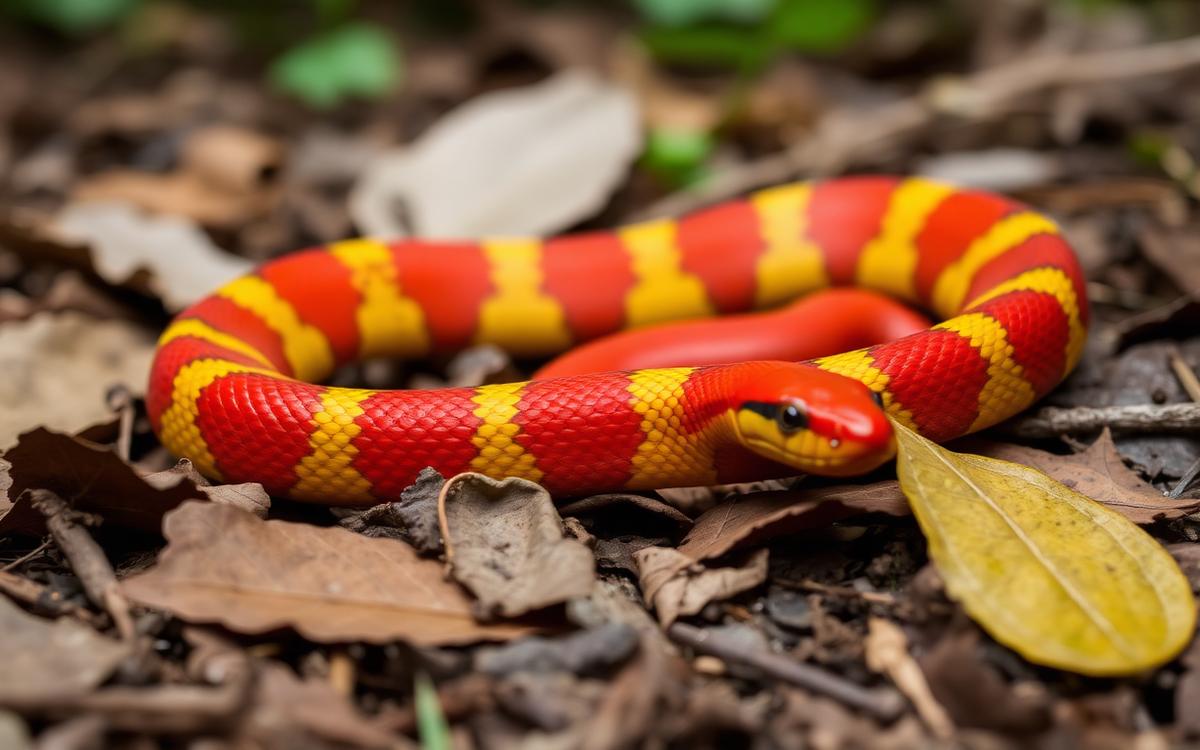
Reviewed against primary toxinology literature and IUCN assessments. This article is educational and is not medical advice — in an emergency contact your local poison centre or emergency services.
Few identification challenges in North American herpetology cause as much anxiety as distinguishing a venomous coral snake from its harmless mimics, especially the scarlet kingsnake and milk snake. Both share a bold pattern of red, yellow (or white), and black bands, an example of Batesian mimicry in which a harmless species evolves to resemble a dangerous one for protection from predators.
The classic children's rhyme, 'red touches yellow, kill a fellow; red touches black, friend of Jack,' is a useful memory aid for snakes found in the United States, but it is not foolproof and does not apply to coral snake species elsewhere in the Americas. This guide breaks down reliable identification methods and why the distinction genuinely matters for safety.
The Rhyme and Its Limits
In the eastern and southern United States, the coral snake (Micrurus fulvius and related species) has red bands bordered by yellow, while its mimics, like the scarlet kingsnake, have red bands bordered by black. This gives rise to the popular rhyme distinguishing 'friend' from 'foe' by band order.
Editor's note: This rhyme applies only to snakes native to the United States. Coral snake species in Mexico, Central America, and South America can have different color patterns entirely, so the rhyme should never be relied upon outside its home range.
Other Physical Differences
- Coral snakes have a blunt, black-banded snout; kingsnakes often have red or lighter-colored snouts
- Coral snakes tend to have thinner, more uniform bodies
- Coral snake bands typically encircle the body completely; some mimics have interrupted bands
- Kingsnakes have round pupils; coral snakes also have round pupils, so pupil shape is not a reliable clue here
Behavior differences
Coral snakes are secretive, spending much of their time burrowed in leaf litter or underground, and are far less likely to bite unless handled or stepped on directly. Kingsnakes are more likely to be seen moving in the open and, if threatened, may vibrate their tails or musk rather than strike.
Why the Difference Matters
Coral snake venom is highly neurotoxic, capable of causing progressive muscle weakness and respiratory failure, though its small, fixed fangs mean it often needs to hold on and chew to deliver a significant dose rather than a single quick strike like a viper.
Coral snake bites are rare in the U.S., with well under 100 reported annually and very few fatalities thanks to available antivenom, but the potential severity means any suspected bite from a red-yellow-black patterned snake requires emergency medical evaluation regardless of species certainty.
Practical Safety Guidance
- Never handle a banded red, yellow, and black snake to test the rhyme in the field
- Photograph the snake from a safe distance if identification is needed
- Treat any bite from a similarly patterned snake as a potential emergency
- Contact local poison control or wildlife services for confirmed identification
When in doubt, the safest approach is always to leave the snake alone and back away slowly, since misidentification carries far more risk than an overly cautious retreat.
Key takeaways
- Coral snakes and their mimics share red, yellow, and black banding through Batesian mimicry.
- The 'red touches yellow' rhyme only applies to snakes native to the United States.
- Coral snakes have black-banded snouts and tend to be more secretive.
- Coral snake venom is highly neurotoxic despite the snake's small fangs.
- Any suspected coral snake bite requires immediate medical attention.
Frequently asked questions
Is the coral snake rhyme always accurate?+
It only reliably applies to coral snakes and mimics native to the United States, not to Central or South American species.
Are milk snakes dangerous?+
No, milk snakes and scarlet kingsnakes are non-venomous and harmless to humans, relying on mimicry for protection rather than venom.
How dangerous is a coral snake bite?+
It can be serious due to neurotoxic venom, but coral snakes have small fangs and often need to chew to inject a significant dose, and bites are rare.
What should I do if I cannot tell the species apart?+
Keep your distance, photograph it if safe to do so, and treat any bite from a similarly patterned snake as a medical emergency.