Spiders & Scorpions · Supporting guide
Wandering Spiders: Separating Medical Fact From Internet Legend
Phoneutria is medically significant and widely exaggerated at the same time. The clinical literature tells a more precise story than the viral posts.
 By Mahmoud OsamaSenior Wildlife Researcher & Editor-in-ChiefPublished 11 June 2026 · Updated 5 August 2026 · 9 min read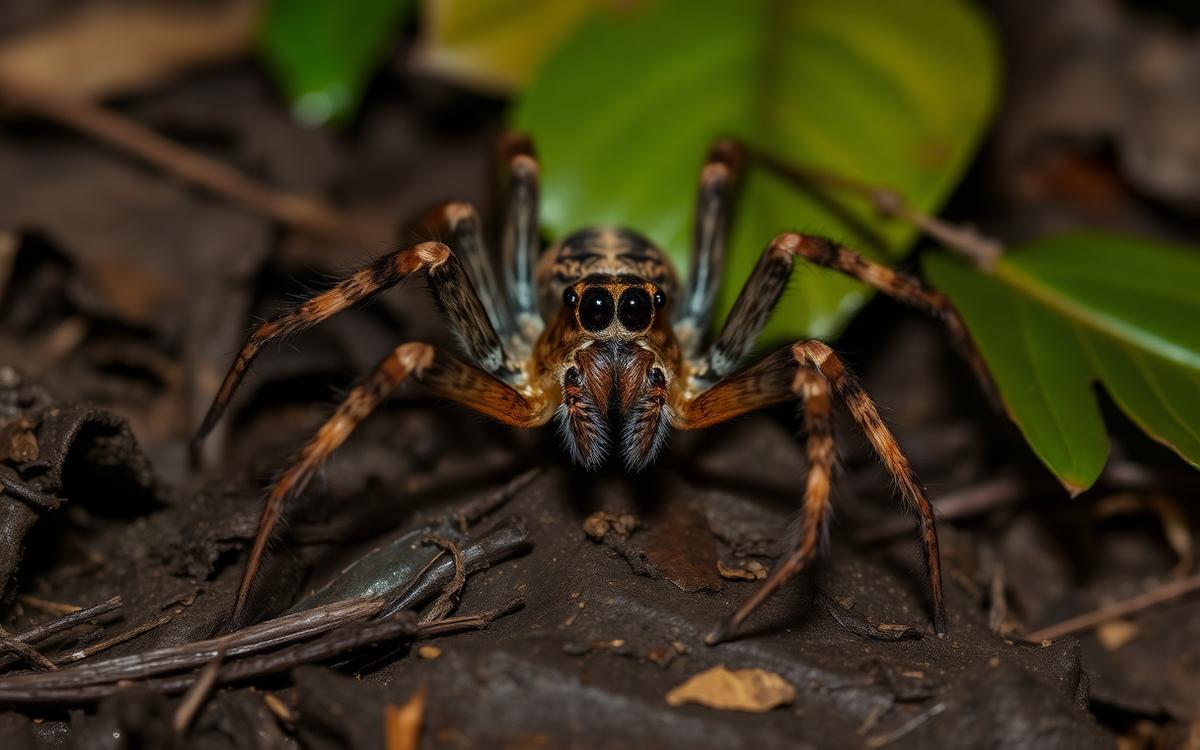
Reviewed against primary toxinology literature and IUCN assessments. This article is educational and is not medical advice — in an emergency contact your local poison centre or emergency services.
Phoneutria species appear in record books as the most venomous spider, and in comment sections as an animal that kills anyone it touches. The clinical record from Brazilian poison centres, which handle thousands of Phoneutria bites annually, shows something different and more useful.
Understanding the gap matters because misidentification and panic cause more harm than the spider does — including unnecessary antivenom use and, in some regions, the destruction of harmless native spiders.
What wandering spiders actually are
Phoneutria is a genus of large ctenid spiders from Central and South America with a leg span reaching 13–15 cm. They do not build capture webs. They hunt at ground level after dark and retreat into dark cavities by day, which is precisely why they turn up in shoes, laundry, banana bunches and cargo.
Their defensive display is distinctive and worth memorising: the spider raises its front two pairs of legs high, exposing red-orange hairs on the underside of the chelicerae, and sways side to side. That posture is a warning, not an attack.
Venom action
The venom contains neurotoxic peptides, notably the PhTx family, which act on sodium and calcium channels. The effect is intense immediate pain, local sweating, elevated blood pressure and, in some cases, systemic autonomic disturbance.
One peptide, PnTx2-6, causes prolonged priapism and has been investigated as a template for erectile-dysfunction drug development. This is the origin of a great deal of internet folklore; it is a genuine research line, and it is also a rare and unpleasant symptom rather than a curiosity.
The clinical reality of bites
Published Brazilian case series consistently find that the overwhelming majority of Phoneutria bites produce local pain only, a minority need antivenom, and deaths are extremely rare — largely confined to young children and cases with delayed care.
- Most bites are dry or low-dose; a defensive spider is not trying to spend venom.
- Local pain, redness and sweating dominate the clinical picture.
- Systemic signs — vomiting, hypertension, tachycardia, agitation, priapism — indicate a need for hospital care and possible antivenom.
- Brazil maintains a specific arachnid antivenom and a national reporting system, which is why the data quality here is unusually good.
The misidentification problem
Outside Phoneutria's native range, virtually every large brown spider photographed in a supermarket banana box gets labelled a wandering spider. Most are huntsman spiders (Sparassidae), which are fast, alarming and medically trivial.
Reliable identification requires close examination of eye arrangement and cheliceral features, and often a specialist. If you are not in tropical Central or South America, the prior probability of a genuine Phoneutria encounter is very low.
What to do after a suspected bite
- Wash the area, keep the limb still and elevated, and apply a cold pack for pain.
- Photograph the spider if it can be done safely. Do not attempt to capture it by hand.
- Contact your national poison information centre — they hold current species-specific protocols.
- Go to hospital promptly for a bitten child, or for any vomiting, chest pain, breathing difficulty, severe hypertension or priapism.
- Do not apply tourniquets, cut the wound, or attempt venom extraction.
Key takeaways
- Phoneutria venom is genuinely potent, but most bites cause local pain only.
- The raised-leg display is a warning posture; back away and it usually leaves.
- Huntsman spiders account for most non-native wandering spider sightings.
- Children and delayed care drive the rare severe outcomes.
- Poison information centres are the correct first call, not social media identification.
Frequently asked questions
Is the Brazilian wandering spider the most venomous spider?+
It is frequently cited as such based on toxicity testing, but venom potency in a laboratory assay is not the same as clinical danger. Bite outcomes depend on dose delivered, victim size and time to treatment.
Can they really arrive in banana shipments?+
Yes, occasionally. Confirmed cases exist, but they are rare and usually involve a single spider, and most reported cases turn out to be harmless species.
How fast do symptoms appear?+
Pain is immediate. Systemic symptoms, if they develop, usually appear within the first one to two hours, which is why observation matters even when the bite looks minor.