Spiders & Scorpions · Cornerstone guide
Deathstalker Scorpion Venom: Toxins, Symptoms and Medical Reality
Leiurus quinquestriatus has one of the most medically significant scorpion venoms on Earth — and one of the most promising for cancer imaging research.
 By Mahmoud OsamaSenior Wildlife Researcher & Editor-in-ChiefPublished 29 March 2026 · Updated 21 July 2026 · 12 min read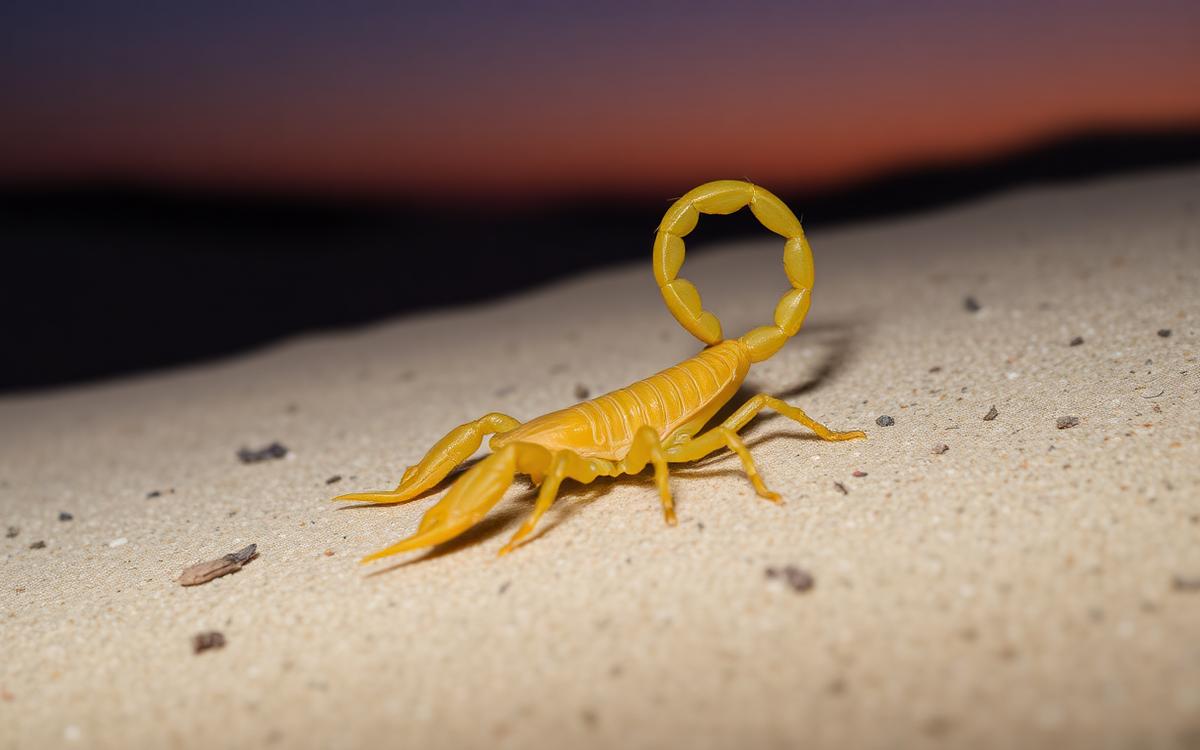
Reviewed against primary toxinology literature and IUCN assessments. This article is educational and is not medical advice — in an emergency contact your local poison centre or emergency services.
The deathstalker is the scorpion most often named when people ask which is the most dangerous. That reputation is broadly justified — but the reasons are more interesting than a lethality ranking, and the same venom is now a serious subject of medical research.
This guide explains the toxin families involved, what an envenomation actually looks like clinically, which populations carry the real risk, and how the venom found its way into surgical oncology.
Biology and distribution
Leiurus quinquestriatus is a buthid scorpion of arid and semi-arid habitats across North Africa and the Middle East, from Egypt and Sudan through the Levant and Arabian Peninsula. Adults reach 8–11 cm, are pale straw-yellow, and shelter by day under stones, in burrows and in wall cracks.
A general rule for scorpions holds here: slender pincers plus a thick tail suggests strong venom, because the animal subdues prey chemically rather than mechanically. Bulky-clawed scorpions with thin tails are usually far less medically significant.
Most human encounters are domestic and nocturnal — a scorpion sheltering in a shoe, under bedding, or in a rural building's masonry. Population density in inhabited areas, not aggression, drives sting statistics.
Toxin families in the venom
Scorpion venom is a peptide library. The deathstalker's contains long-chain neurotoxins that act on voltage-gated sodium channels, short-chain peptides that block potassium channels, and chloride-channel binders.
- Sodium-channel toxins delay channel inactivation, causing repeated firing of nerves and a massive release of catecholamines — the source of the sweating, racing heart and agitation seen in severe cases.
- Potassium-channel blockers such as charybdotoxin alter membrane excitability and are widely used as research tools in ion-channel physiology.
- Chlorotoxin binds preferentially to certain tumour cells, which is why an engineered derivative has been studied as a tumour paint to highlight glioma margins during surgery.
Editor's note: The medical research angle does not make the animal safe. Purified fractions studied in laboratories are not the same as whole venom delivered into human tissue.
Envenomation symptoms and grading
Clinicians in endemic regions typically grade scorpion envenomation in three levels, and the grade drives treatment far more than the species name does.
Grade I — local
Intense pain and paraesthesia at the site with little or no swelling. Most stings in adults stop here. Pain peaks within an hour and settles over several hours.
Grade II — systemic, mild to moderate
Sweating, salivation, nausea, vomiting, abdominal cramps, restlessness, elevated blood pressure and tachycardia. Requires observation in a facility.
Grade III — severe
Pulmonary oedema, cardiac dysfunction, shock, seizures or altered consciousness. This is a critical-care emergency and is disproportionately seen in young children and small adults, where venom dose per kilogram of body mass is far higher.
Treatment and antivenom
First aid is deliberately minimal: keep the person calm and still, clean the site, apply a cold pack for pain, and get to a hospital that stocks appropriate antivenom if systemic signs appear. Do not cut, suck, apply a tourniquet, or use electric shock — all have been studied and none help.
In hospital, the mainstays are analgesia, careful monitoring of cardiovascular and respiratory status, and species-appropriate antivenom where indicated. Prazosin is used in some protocols to counter catecholamine effects. Antivenom availability and policy vary substantially between countries, and local guidance always takes precedence over general articles like this one.
Household prevention in endemic areas
- Shake out shoes, clothing and bedding before use.
- Seal wall cracks and gaps under doors; fit fine mesh over vents.
- Move woodpiles, rubble and stones away from exterior walls.
- Use a torch when walking outdoors at night; a UV torch makes scorpions fluoresce and is the single most useful survey tool.
- Lift stones toward you so the underside faces away from your hand.
Key takeaways
- Deathstalker venom acts mainly on ion channels, triggering a catecholamine storm rather than tissue destruction.
- Most adult stings remain local and painful; children face far higher risk of severe systemic effects.
- Antivenom exists and is region-specific; treatment decisions follow clinical grade, not species reputation.
- Chlorotoxin from this venom is a genuine research subject in tumour imaging.
- Simple household measures prevent most stings in endemic regions.
Frequently asked questions
How deadly is a deathstalker scorpion sting?+
Fatalities are uncommon in adults with access to medical care but are a real risk for young children, the elderly and people with cardiac disease. Rapid access to a hospital is the main determinant of outcome.
How long do symptoms last?+
Local pain typically peaks within an hour and eases over 12 to 24 hours. Systemic effects, when they occur, usually develop within the first hour and are managed over 24 to 48 hours in hospital.
Do UV torches really reveal scorpions?+
Yes. Scorpion cuticle fluoresces blue-green under ultraviolet light, which makes night surveys and household checks dramatically more effective.