Rare & Endangered Animals · Supporting guide
Amur Leopard: The Rarest Big Cat's Fight to Survive in Northeast Asia
Adapted to snow and cold forests unlike any other leopard subspecies, the Amur leopard has climbed back from fewer than 30 wild cats to roughly 100–130 today.
 By Mahmoud OsamaSenior Wildlife Researcher & Editor-in-ChiefPublished 20 September 2025 · Updated 20 September 2025 · 7 min read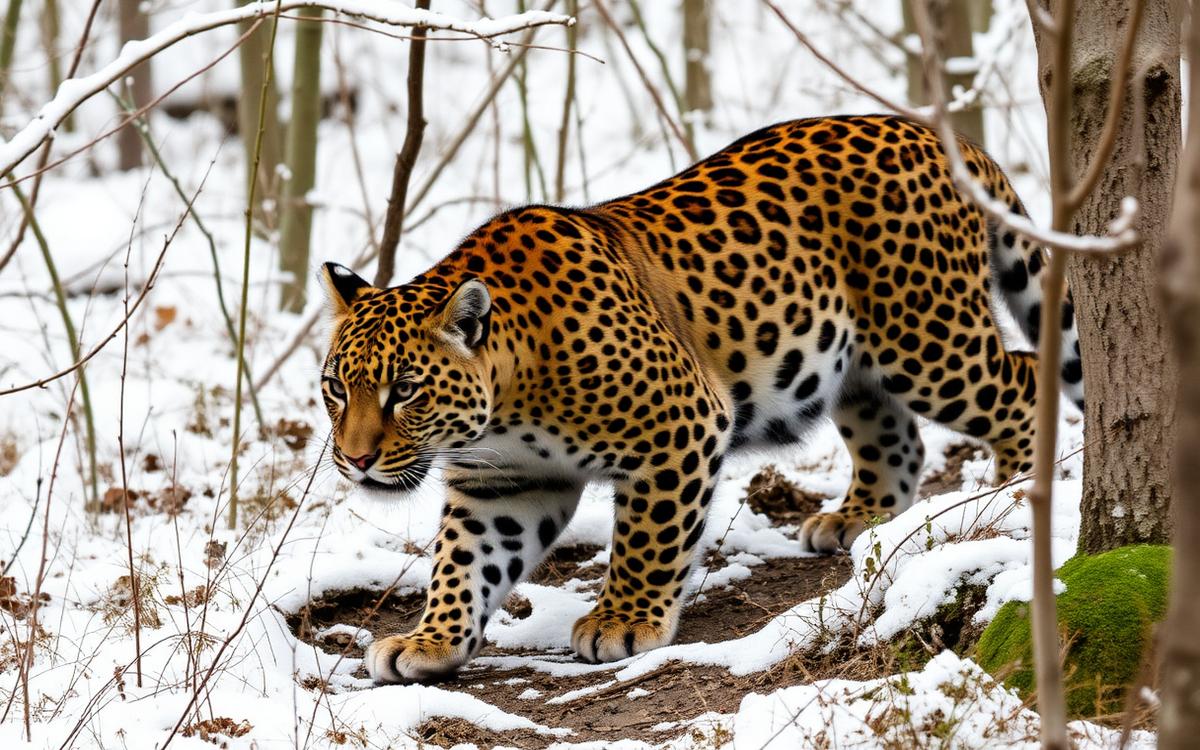
Reviewed against primary toxinology literature and IUCN assessments. This article is educational and is not medical advice — in an emergency contact your local poison centre or emergency services.
The Amur leopard (Panthera pardus orientalis), also called the Far Eastern leopard, is a subspecies adapted to the cold temperate forests of the Russian Far East and adjacent northeastern China, a stark contrast to the tropical and savanna habitats most leopards occupy. Decades of poaching, habitat loss, and prey depletion drove the subspecies down to an estimated 25 to 40 individuals in the wild by the early 2000s, a population so small that extinction seemed a realistic near-term outcome.
Coordinated conservation between Russian and Chinese wildlife authorities, along with international NGOs, has since produced one of the more encouraging recovery stories among the world's big cats. Camera-trap census work now puts the wild population at roughly 100 to 130 individuals, still critically low but a meaningful rebound that offers cautious optimism alongside continued vulnerability.
Adaptations to a Cold Climate
Amur leopards carry notably thick, pale winter coats that can grow up to 7.5 centimeters long, along with longer legs relative to body size, both adaptations for moving through deep snow and enduring temperatures that can drop below minus 30 degrees Celsius.
- Estimated wild population: roughly 100–130 individuals (Russia and China combined)
- Range: Primorye region of Russia and adjacent Jilin and Heilongjiang provinces, China
- Solitary, territorial hunters preying mainly on deer and wild boar
- Distinguished from other leopard subspecies by pale coat and widely spaced rosettes
Threats
Poaching for skins and bones, along with retaliatory killing near farmland, historically devastated the population. Habitat fragmentation from logging, agriculture, and infrastructure development further isolated remaining leopards, while depletion of deer and boar prey populations by human hunters reduced food availability.
A narrow genetic base
Because the population fell so low, genetic diversity in Amur leopards is unusually limited, raising concerns about inbreeding depression, reduced fertility, and lower resilience to disease even as raw numbers recover.
Conservation Progress
Russia's Land of the Leopard National Park, established in 2012, protects the core breeding habitat and has been central to the population's recovery, alongside anti-poaching patrols and cross-border cooperation with Chinese reserves.
Editor's note: The IUCN Red List classifies the Amur leopard as Critically Endangered, though its trend has been assessed as increasing in recent years.
- Land of the Leopard National Park established (2012) to protect core habitat
- Cross-border monitoring between Russia and China tracking leopard movement
- Captive breeding and reintroduction planning explored as long-term insurance
- Community programs addressing human-wildlife conflict near farmland
Outlook
The Amur leopard's recovery from fewer than 30 to over 100 individuals within roughly two decades demonstrates that intensive, cooperative conservation can meaningfully move the needle even for critically endangered big cats, though the population remains far below levels considered secure.
Key takeaways
- Amur leopards number roughly 100–130 in the wild, up from an estimated 25–40 in the early 2000s.
- The subspecies is uniquely adapted to cold, snowy forest habitat unlike other leopards.
- Land of the Leopard National Park in Russia protects the core breeding population.
- Low genetic diversity remains a long-term concern despite numerical recovery.
- The IUCN lists the Amur leopard as Critically Endangered with an increasing trend.
Frequently asked questions
How many Amur leopards are left in the wild?+
Current estimates suggest roughly 100 to 130 individuals across Russia's Primorye region and adjacent parts of northeastern China.
Where do Amur leopards live?+
They inhabit temperate forests along the Russia-China border, primarily within and around Land of the Leopard National Park in Russia.
Why is the Amur leopard population still at risk despite recovery?+
The population remains small and genetically narrow, making it vulnerable to disease, inbreeding effects, and any renewed poaching or habitat loss.
What makes the Amur leopard different from other leopards?+
It has a thick, pale winter coat and longer legs adapted for snow and cold, unlike leopard populations in Africa or tropical Asia.