Reptiles & Amphibians · Supporting guide
Poison Dart Frogs: Why Captive Ones Are Harmless
The golden poison frog carries enough batrachotoxin to matter — but only while it eats the right arthropods in the right forest.
 By Mahmoud OsamaSenior Wildlife Researcher & Editor-in-ChiefPublished 27 May 2026 · Updated 1 August 2026 · 8 min read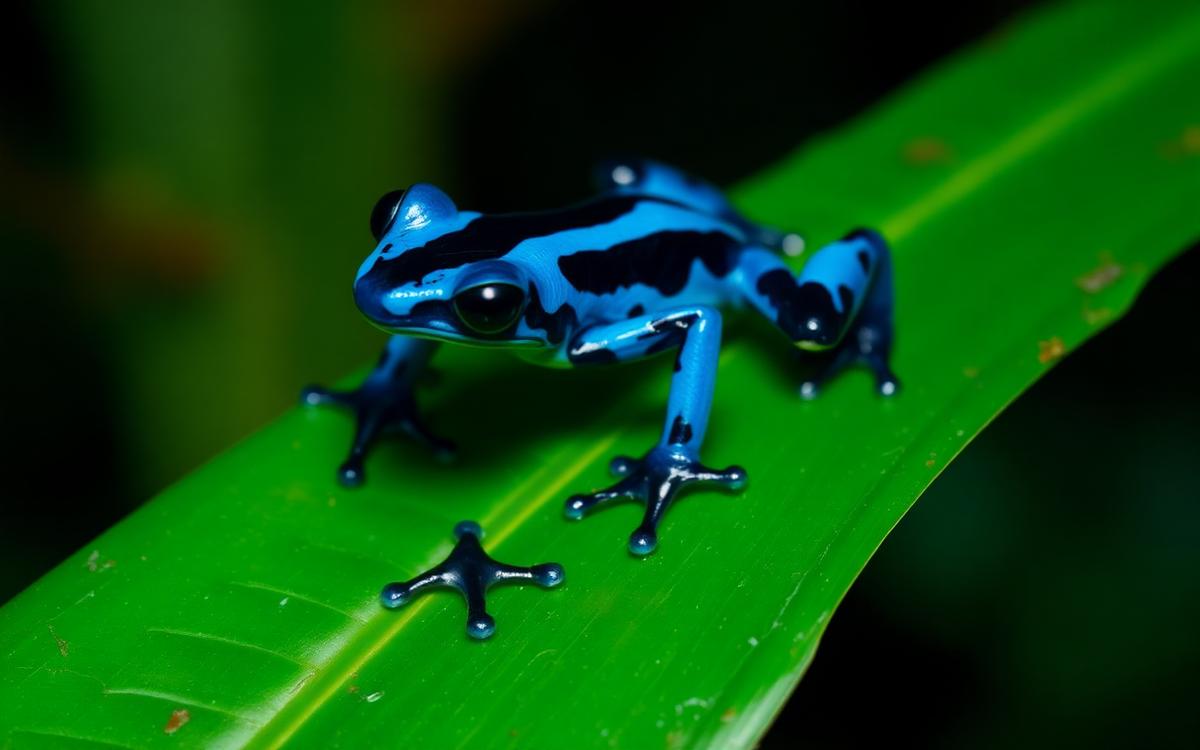
Reviewed against primary toxinology literature and IUCN assessments. This article is educational and is not medical advice — in an emergency contact your local poison centre or emergency services.
Poison dart frogs are the standard example of aposematism: bright colours announcing that an animal is not worth eating. What is less widely known is that the toxicity is borrowed. Move the frog, change its diet, and within a generation the chemistry disappears.
This article covers the poison-versus-venom distinction, the actual mechanism of batrachotoxin, which species are genuinely dangerous, and why the pet-trade animals in a shop tank pose no toxic risk at all.
Poisonous is not venomous
Venomous animals actively inject toxins through a delivery structure — fangs, stingers, spines. Poisonous animals are harmful when touched or eaten; they have no injection apparatus. Dart frogs are firmly in the second group: their toxins sit in skin glands and work as a deterrent to predators.
This distinction has practical consequences. A dart frog cannot attack you. Risk requires the toxin to reach mucous membranes or an open wound, which is why the traditional use involved wiping the frog's skin along a dart tip.
How batrachotoxin works
Batrachotoxin, concentrated in Phyllobates species, binds to voltage-gated sodium channels and locks them open. Nerve and muscle cells cannot repolarise, so they stop functioning. In sufficient dose the result is cardiac arrhythmia and respiratory paralysis.
There is no antidote. The species of greatest concern, the golden poison frog Phyllobates terribilis, carries a quantity that is genuinely significant relative to human body weight, which is why it is handled with gloves even by specialists.
Editor's note: Most of the 200-plus dart frog species carry far weaker alkaloids that cause only irritation and unpleasant taste. Toxicity varies enormously across the family.
Toxins come from the diet
Dart frogs do not synthesise their alkaloids. They sequester them from prey — mites, small ants, beetles and other leaf-litter arthropods that carry the compounds, which the frogs concentrate and store in dermal glands.
The evidence for this is straightforward: captive-bred frogs raised on fruit flies and pinhead crickets are non-toxic, and wild-caught frogs lose potency over months in captivity. Reintroducing alkaloid-containing prey restores it. This is one of the cleanest diet-toxicity relationships known in vertebrates.
Conservation and the pet trade
Many dart frog species have small ranges in Colombia, Ecuador, Panama and the Guianas, which makes them vulnerable to deforestation and to chytrid fungus. Several are listed as Endangered or Critically Endangered.
- Buy only captive-bred animals from breeders who can document lineage.
- Wild collection for the pet trade adds pressure to already small populations.
- Chytridiomycosis has driven amphibian declines worldwide; hobbyist biosecurity matters.
- Never release captive amphibians into any wild habitat.
Key takeaways
- Dart frogs are poisonous, not venomous — they have no injection mechanism.
- Batrachotoxin holds sodium channels open, causing paralysis; there is no antidote.
- Toxins are sequestered from arthropod prey, so captive-bred frogs are harmless.
- Only a handful of species, chiefly Phyllobates terribilis, carry a human-relevant dose.
- Habitat loss and chytrid fungus are the main threats to the family.
Frequently asked questions
Can touching a poison dart frog kill you?+
For the vast majority of species, no — brief skin contact causes at most irritation. Phyllobates terribilis is the exception that warrants gloves and careful handling.
Are pet poison dart frogs dangerous?+
Captive-bred dart frogs raised on standard feeder insects do not produce meaningful toxins and are considered safe to keep.
Why are they so brightly coloured?+
Aposematism. Vivid colour is a learned warning signal to visually hunting predators, and it works because the association is reinforced across a predator's lifetime.