Venomous Insects · Cornerstone guide
The Bullet Ant Sting: Why Paraponera clavata Tops the Pain Index
Rated 4.0+ on the Schmidt sting pain index, the bullet ant delivers a peptide that hijacks sodium channels. Here is what happens hour by hour — and what actually helps.
 By Mahmoud OsamaSenior Wildlife Researcher & Editor-in-ChiefPublished 4 May 2026 · Updated 10 August 2026 · 11 min read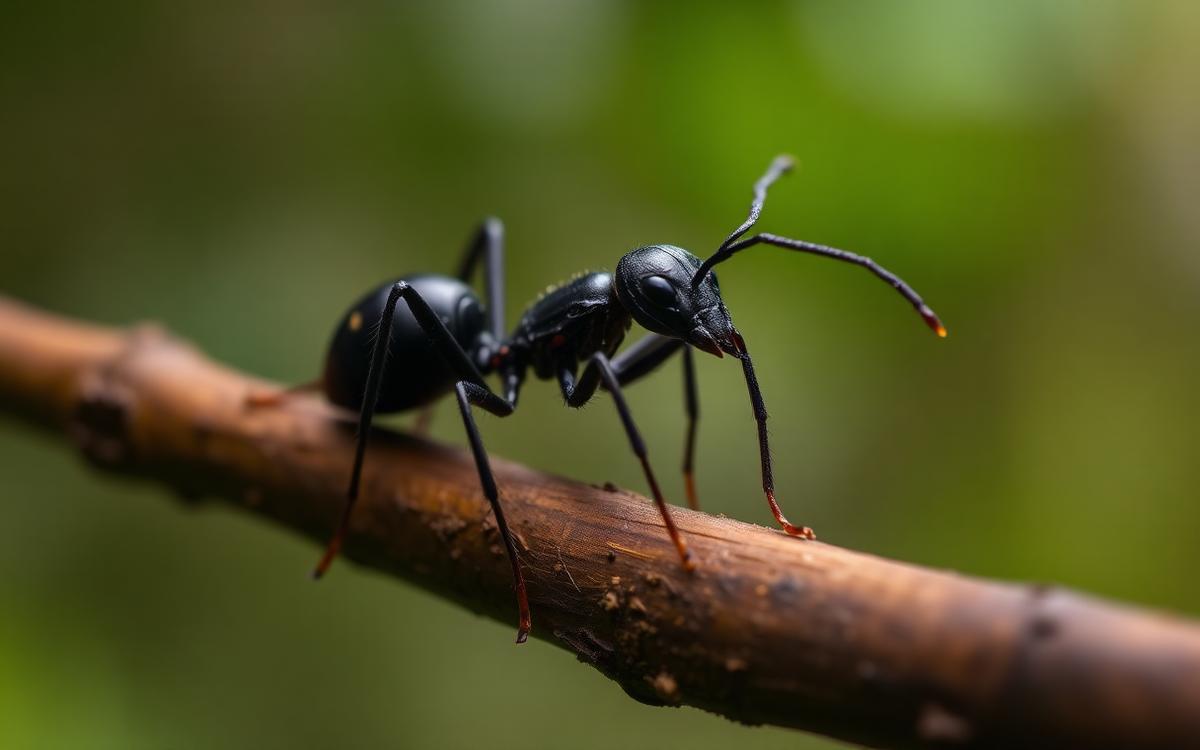
Reviewed against primary toxinology literature and IUCN assessments. This article is educational and is not medical advice — in an emergency contact your local poison centre or emergency services.
Few animals have a reputation as specific as the bullet ant's. Entomologist Justin Schmidt, who let himself be stung by more than 80 species to build his sting pain index, gave Paraponera clavata the top score and described the sensation as pure, intense, brilliant pain — like walking over flaming charcoal with a rusty nail in your heel.
That description travels well on social media, but it explains almost nothing about the biology. This guide covers what the venom contains, why the pain lasts so much longer than a wasp sting, what a realistic symptom timeline looks like, and which treatments are supported by clinical evidence rather than folklore.
What is a bullet ant?
Paraponera clavata is a large ponerine ant found in humid lowland rainforest from Nicaragua south to Paraguay. Workers measure roughly 18–30 mm, forage individually along tree trunks at night, and nest at the base of large trees. Colonies are modest — often a few hundred to a few thousand workers — which is why encounters are usually with a single ant rather than a swarm.
The common name is behavioural, not anatomical: people describe the sting as feeling like being shot. In parts of Brazil the species is called formiga-cabo-verde or tocandira, and it features in Sateré-Mawé initiation ceremonies in which young men wear gloves lined with living ants.
Bullet ants are not aggressive by disposition. Stings almost always follow accidental contact — a hand placed on a trunk, a brushed branch, or disturbance near a nest entrance. They give warning first: a shrill stridulation and a released alarm pheromone that observers often smell before they see the ant.
Venom chemistry: what poneratoxin does
The dominant active component is poneratoxin, a small peptide of 25 amino acids. Rather than destroying tissue, it binds to voltage-gated sodium channels in nerve and muscle membranes and prevents them from inactivating normally. Neurons that should fire once and reset instead fire repeatedly.
The practical consequence is that the nervous system keeps generating pain signals long after the venom dose itself is small and localised. It also explains the involuntary muscle effects many people report: trembling, twitching and, in the stung limb, waves of cramping that come and go for hours.
Why it hurts longer than a wasp sting
Wasp venoms typically combine tissue-damaging enzymes with amines that trigger a fast, sharp, short-lived response. Bullet ant venom takes a different route: it is comparatively low in cytolytic enzymes and high in a neuro-active peptide. Tissue damage is minor, which is why the sting rarely leaves a scar, but nerve signalling is disrupted for far longer.
Symptom timeline after a single sting
Reports from field workers and case literature converge on a fairly consistent progression for a healthy adult receiving one sting:
- 0–5 minutes: immediate burning pain out of proportion to the visible wound; a small puncture with slight redness.
- 5–60 minutes: pain intensifies and radiates up the limb; sweating, and often uncontrollable trembling of the affected arm or leg.
- 1–5 hours: peak phase. Throbbing waves, lymph node tenderness, sometimes nausea and a rapid heart rate.
- 5–12 hours: waves become less frequent; the limb feels heavy and clumsy.
- 12–24 hours: residual ache and stiffness. Most people sleep poorly on the first night.
- 24–48 hours: near-complete resolution; mild tenderness at the puncture site can persist a few days.
Editor's note: Multiple stings, stings to the face or neck, and stings in people with prior insect-venom allergy change this picture entirely and are a medical emergency.
Evidence-based treatment
There is no antivenom for Paraponera and none is needed for isolated stings in healthy adults. Management is symptomatic, and the goals are pain control, reassurance and watching for the rare allergic reaction.
- Move away from the area — the alarm pheromone recruits nearby workers.
- Wash the site with soap and water; there is no stinger to remove, as ants retain theirs.
- Apply a cold pack for 10–15 minutes at a time to reduce local swelling and dull the pain.
- Use standard oral analgesia as directed on the packaging; combining paracetamol and an NSAID is common practice where both are appropriate.
- Elevate and rest the limb. Do not attempt to walk out of difficult terrain alone if a leg is affected — coordination is unreliable during the peak phase.
- Seek emergency care immediately for breathing difficulty, throat tightness, widespread hives, dizziness or collapse.
What not to do
Cutting, suction devices, tourniquets, applying heat, and topical bleach or ammonia have no supporting evidence and can cause secondary injury or infection. Alcohol does not neutralise the venom and may worsen the perception of pain by increasing peripheral blood flow.
Field avoidance for travellers and researchers
The bullet ant is one of the easier dangerous invertebrates to avoid because it is large, mostly nocturnal and slow to escalate. In eight years of Neotropical fieldwork, every sting I have witnessed came from placing an unlit hand somewhere.
- Use a head torch at night and look before you touch trunks, buttress roots or lianas.
- Wear gloves for any work involving bark, deadwood or leaf litter.
- Shake out boots and clothing before dressing at camp.
- Keep tents zipped and off the base of large trees where nests concentrate.
- If you hear stridulation near your hand, withdraw slowly — sudden movement provokes a strike.
Ecological role and conservation context
Bullet ants are generalist predators and nectar feeders that move a meaningful volume of arthropod biomass through the forest understorey. They are also prey — phorid flies parasitise foragers, and antbirds track their columns.
The species is not currently considered threatened, but it is tied to intact lowland rainforest and disappears from heavily fragmented sites. Where the ant is gone, the fragment usually has other problems.
Key takeaways
- Bullet ant venom is dominated by poneratoxin, which keeps sodium channels open and prolongs nerve firing.
- Pain peaks in the first few hours and typically resolves within 24 hours in healthy adults.
- No antivenom exists or is needed for a single sting; treatment is cold, analgesia, elevation and observation.
- Anaphylaxis is rare but is the only life-threatening outcome — know its signs.
- Nearly all stings are avoidable with light, gloves and slow hands.
Frequently asked questions
Can a bullet ant sting kill you?+
A single sting is not considered lethal to a healthy adult. The realistic danger is an allergic reaction (anaphylaxis), or a very large number of stings in a child or a person with a heart condition. Any sign of breathing difficulty or collapse warrants emergency care.
How long does bullet ant pain last?+
Severe pain generally peaks within one to five hours and fades over 12 to 24 hours. Mild tenderness at the site can linger for several days.
Is the bullet ant the most painful insect sting?+
It holds the highest rating on the Schmidt sting pain index at 4.0+, judged on intensity and duration together. The tarantula hawk wasp is arguably more intense for a few minutes, but its pain fades quickly.
Where do bullet ants live?+
Humid lowland rainforest from Nicaragua through Central America into the Amazon basin and as far south as Paraguay, usually below 750 m elevation.