Reptiles & Amphibians · Supporting guide
Boomslang and Rear-Fanged Snakes: An Underestimated Danger
Rear-fanged colubrid snakes were long dismissed as harmless, until the boomslang's potent, slow-onset venom proved otherwise in tragic fashion.
 By Mahmoud OsamaSenior Wildlife Researcher & Editor-in-ChiefPublished 6 November 2025 · Updated 6 November 2025 · 7 min read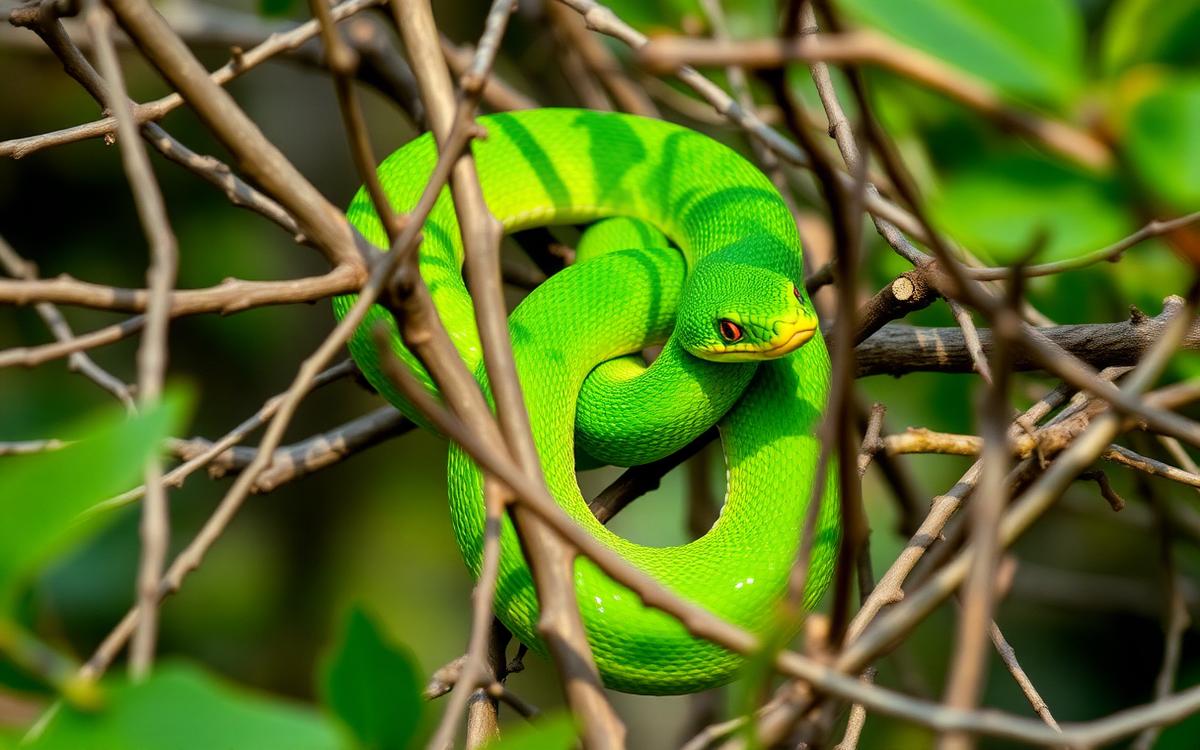
Reviewed against primary toxinology literature and IUCN assessments. This article is educational and is not medical advice — in an emergency contact your local poison centre or emergency services.
For much of the 20th century, herpetologists assumed that snakes with fangs positioned at the back of the mouth, called rear-fanged or opisthoglyphous snakes, posed little threat to humans because their bites were thought to be too weak or awkwardly placed to deliver a dangerous dose. The boomslang (Dispholidus typus) of sub-Saharan Africa shattered that assumption in tragic and instructive fashion.
In 1957, herpetologist Karl Schmidt died after a juvenile boomslang bit him during a museum examination; because he believed rear-fanged snakes were not seriously dangerous, he delayed seeking treatment and meticulously documented his own symptoms until fatal internal bleeding developed. His death reshaped how toxinologists classify and respect rear-fanged species.
Boomslang Biology and Venom
The boomslang is a slender, large-eyed arboreal snake found across much of sub-Saharan Africa, growing to around 1.5 to 2 meters. Its name is Afrikaans for 'tree snake,' reflecting its preference for hunting chameleons, birds, and eggs in trees and shrubs.
Its venom is strongly hemotoxic, containing potent hemorrhagic components that disrupt the blood clotting cascade, leading to internal and external bleeding that can develop hours after a bite rather than causing immediate dramatic symptoms.
Editor's note: The delayed onset of boomslang envenomation, sometimes 12 to 24 hours, is precisely what made Schmidt underestimate the danger of his bite.
How Rear-Fanged Venom Delivery Works
Unlike front-fanged vipers and elapids, opisthoglyphous snakes have enlarged, grooved teeth positioned toward the back of the upper jaw. Venom flows along grooves rather than through a hollow hypodermic-like fang, generally requiring a longer, chewing-style bite to deliver a substantial dose.
- Most rear-fanged colubrids are harmless to humans due to low venom potency or the physical difficulty of a deep bite
- A minority, including the boomslang and the twig snakes (Thelotornis species), produce medically significant venom
- Rear-fanged bites are often initially painless, which can lead victims to underestimate their seriousness
- Specific antivenom exists for boomslang bites but is scarce and produced in very limited quantities
Recognizing and Treating a Boomslang Bite
Watch for Delayed Bleeding Symptoms
Early signs include headache, nausea, and drowsiness, followed by bleeding from the gums, nose, and injection sites, blood in urine or vomit, and widespread bruising as clotting factors are consumed.
The South African Vaccine Producers institute manufactures a monovalent antivenom specifically for boomslang bites, though because envenomations are rare, hospitals in the boomslang's range may need to source it from specialized reptile parks or regional suppliers.
Other Notable Rear-Fanged Snakes
Twig snakes (Thelotornis capensis and related species) share a similarly potent hemotoxic venom profile to the boomslang and are found in overlapping African habitats, posing comparable risk to handlers and researchers.
The hognose snakes of North America and many vine snakes are also technically rear-fanged and mildly venomous, but their venom is generally considered harmless to humans beyond localized swelling, and severe reactions are exceptionally rare.
Guidance for Snake Handlers and Researchers
- Never assume a rear-fanged snake is harmless without confirming the species and its known venom profile
- Treat any bite from an unidentified colubrid seriously and monitor for delayed symptoms over 24 hours
- Photograph the snake safely for identification rather than attempting to capture or kill it
- Institutions working with boomslangs or twig snakes should pre-arrange antivenom access before handling live specimens
- Report any bite to poison control or a toxicology service immediately, even if there is no initial pain or swelling
Key takeaways
- The boomslang is a rear-fanged African snake whose hemotoxic venom disrupts blood clotting.
- Rear-fanged bites are often painless initially, and symptoms can be delayed by many hours.
- Herpetologist Karl Schmidt's 1957 death from a boomslang bite reshaped attitudes toward rear-fanged snakes.
- A specific but scarce antivenom exists for boomslang envenomation.
- Most rear-fanged colubrids are harmless, but species like twig snakes share the boomslang's dangerous venom profile.
Frequently asked questions
Is the boomslang the most dangerous rear-fanged snake?+
It is one of the most medically significant, alongside the closely related twig snakes, due to its potent hemotoxic venom and documented human fatalities.
Why did Karl Schmidt not seek treatment for his boomslang bite?+
He believed rear-fanged snakes could not deliver a dangerous bite and chose to observe and record his symptoms scientifically instead of seeking immediate care, a decision that proved fatal.
Are hognose snakes dangerous to humans?+
Hognose snakes are technically rear-fanged and mildly venomous, but bites to humans typically cause only minor local swelling and are not considered medically serious.
How rare are boomslang bites to humans?+
Bites are rare because boomslangs are shy and avoid confrontation, with most documented cases involving snake handlers or researchers.
What should I do if bitten by an unidentified snake in Africa?+
Seek medical attention immediately, note the snake's appearance if safely possible, and inform doctors of the delayed-onset risk associated with rear-fanged species.